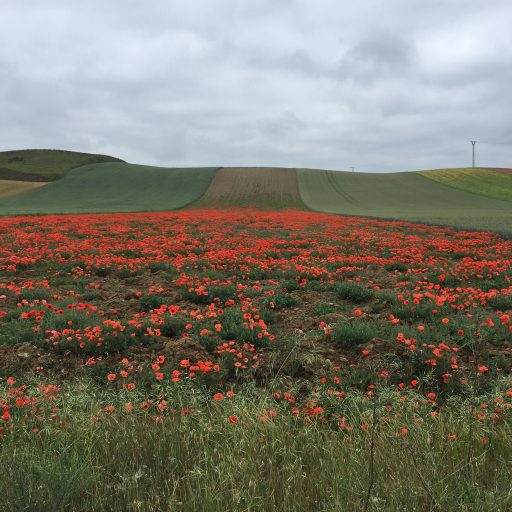
Weaving down aisles,
I bump carts with women
who wear framed glasses
that remind me of my own,
and I wonder if they stay up
late like me, reading poetry,
jotting down dreams.
-
Grocery Stone
-
Shopping at Shangri-La
Christmas Shopping at the Chinese Restaurant
Pashmina shawl, teal green,
an abacus pencil sharpener,
wasabi-spiced dried peas,
the aroma of yak butter tea
as a waitress passes with a tray.December 21
-
Red Holiday
Red got into the dog biscuits and then spit up on our comforter. I washed the comforter, but it still smells like barf. Good thing I bought it on sale with a coupon!
He also chewed up my yoga mat while I was in the room with him. I was writing, or on Facebook, some kind of nonsense.
We’ve replaced the space heater whose cord he chewed. My meditation cushion is covered with dog hair. He has dug two giant holes in the yard and has tracked the dirt onto the living room rug.
He barks whenever Duffy is on my lap.
He barks a throaty, deep roar whenever Duffy yaps at the UPS drivers.
Of course there’s a “but” in this post.
But he’s just amazed to find out each day that he’s a dog. Life perplexes him, and he yelps in response. He prances like a pony in a field when I come up the stairs.
Sean just found a sock Red nabbed.



-
Sleeping Stone
Under a pile of blankets, Freeboarder sleeps on the couch. A movie about dreams plays on the TV screen, unwatched.
December 20
-
Skipping Stones Into the River
My first small stone has the moon in it! From a certain perspective, the moon really is a very tiny stone, and from where I stand, it looks quite polished.
A River of Stones is a daily writing project for the month of January, started by Fiona Robyn and her partner, Kaspalita. Fiona said their site has received over 5,000 hits today alone. Although the project officially begins after the New Year, I’m starting now because I’m hoping these small stones will inspire some new poems. At the very least I’ll reignite (I want to say “rekindle,” but “kindle” has been over exposed lately) my daily writing practice.
Driving Down Johnson’s Ferry Rd.
On the way home from yoga,
I see the almost-full moon
above a strip mall. Telephone
poles and pines are in dark relief
against a stripe of orange sky.
Tonight the trees’ black branches
seem to shepherd the sun past the hills.December 19
-
Yoga Nidra and Holidays
If there’s too much commotion in your life these days, try a little lying down meditation. If you fall asleep, that’s OK. Just try again! I’ve heard that twenty minutes of yogic sleep can be as restorative as eight hours of regular sleep.
Introduction to Yoga Nidra
Yoga Nidra is a form of guided relaxation practiced while lying down. Swami Satyananda Saraswati, who also founded the Bihar School of Yoga, first developed the practice in the 1940s in India. While listening to the naming of fifty-four body parts, the practitioner enters a state of deep relaxation– the body enters a state similar to sleep, but the mind remains aware.
Practical concerns
Since you will spend from thirty to forty-five minutes lying on the floor, it’s important to find a comfortable position. A blanket on top of a yoga mat helps cushion the surface area. A rolled up blanket under the knees can ease any discomfort felt in the low back. Once you find a comfortable position, try not to move. If you feel you absolutely have to move, make your movement as minimal as possible, keeping in mind that the intention is to allow the body to completely relax.If lying down is not an option for you, it’s fine to practice Yoga Nidra while sitting. Assume the Egyptian God posture, with the feet flat on the floor, hands and forearms resting on the thighs, palms facing up. Feel your sitting bones grounded on the chair, with your spine upright and supported. Allow your head to rest by gently tilting the chin toward the chest.
Yoga Nidra is typically practiced on the floor, not in bed. The room temperature should be comfortable. If you’re cold, cover up with a blanket. The idea is to stay aware, not to fall into the oblivion of sleep. If you do fall asleep, or if you get lost in thought, try not to be hard on yourself. With practice you will remain more focused.
Useful terms
• Yoga Nidra: This term originated with Satyananda Saraswati. Yoga means union in English, and Nidra translates as sleep. Yoga Nidra has also been translated as the sleep of the yogis. During the practice, the mind is conscious, but the body relaxes. It is the conscious relaxation of the body that brings about the deep-seated rest enjoyed when practicing Yoga Nidra.
• Pratyahara: withdrawal of the senses in order to focus the mind inwardly; one of the eight limbs of raja yoga outlined in the yoga sutras of Patanjali, a second-century Indian sage.
• Sankalpa: a seed of thought the practitioner plants in his or her own mind; a resolve; an intention; directing the mind toward a desired outcome.
Sources:
Yoga Nidra, by Swami Satyananda Sarawsati, Yoga Publications Trust, Bihar, India.
Yoga Nidra, by Richard Miller, Sounds True, 2005, Boulder, Colorado
The Living Yoga Program, Donna Belk, Charles MacInerney, and Ellen B. Smith.
-
Online Resources for Gwendolyn Brooks
Gwendolyn Brooks (1917-2000) is best known for her sonnets and ballads, although after 1967 she wrote primarily in free verse. She is associated with the Black Arts movement, but because of the breadth and scope of her writing, many place her in a category all her own. She was the first African American to win the Pulitzer Prize.
Below is a partial list of some of the items included in an annotated bibliography I prepared for a course in 20th century American poetry. I’ve only listed the resources available online, but there are plenty to keep you busy for an hour or so.
Although there are many free recording of Gwendolyn Brooks online, Poets.org sells a wonderful CD of Lucille Clifton and Brooks reading at the Guggenheim Museum in 1983. Brooks tells wonderful back stories to her poems that are entertaining in and of themselves.
The Library of Congress Website for Gwendolyn Brooks
Armenti, Peter. “Gwendolyn Brooks: Online Resources.” 30 July, 2010. Web Guides, US Poet Laureates, Virtual Services Digital Reference Services, US Library of Congress.
A list of just about every type of Brooks-related items: audio recordings, videos, websites, lesson plans, books, reviews, obituaries, histories, and criticism.
In his critical examination of The World of Gwendolyn Brooks (Harper, 1971), a collection of her poems from over three decades of work, Houston Baker offers a succinct summary of many classic Brooks poems, as well as an exploration of her interest in race, gender, and class. He also shows how her work grew out of, yet differed from, the poetry of such well-known African American writers as Countee Cullen and Langston Hughes.
Brooks is one of only a few American poets included in the BBC poetry archives. This BBC website contains a brief but informative biography, as well as recordings of Brooks reading the following seven poems: “Kitchenette Building,” “The Mother,” “a song in the front yard,”? “of DeWitt Williams on his way to the Lincoln Cemetery,” “We Real Cool,” “The Lovers of the Poor,” and “A Sunset of the City.”
Many of Brooks’ poems first appeared in Poetry, which has enabled this website to share a great number of her poems, including those written after her pivotal Fisk University experience. There is an excellent critical biography and a long list of both recorded and printed poems. I especially like the details about her publishing experiences after she left Harper’s. There is also a long list of reviews, books, biographies, and obituaries for those who might be interested in conduction a more in-depth research of Brooks’ work.
Contains a copy of “The Ballad of Pearl May Lee” from her first book, A Street in Bronzeville, 1945. Also included is a brief but useful note on how Brooks fits into both the Harlem and the Chicago Renaissance.
-
Emily Dickinson and the Via Negativa
My friend Dave Bonta has made a beautiful podcast in honor of Emily Dickinson’s 180th birthday. In under 24 hours he invited several poets and writers to record their renditions of three poems by Emily Dickinson, which he put together in his regular podcast, “Woodrat.”
I happened to see his final call for readings on Facebook, so I woke up the next day and made my recordings. Every time I think I’ll deactivate my Facebook account something good happens because I was there, so for now I’m going to work at merely curtailing my use of said network.
I knew something was in the air on Thursday night when I read my friend Collin Kelley’s tweet about some ED poems he would be reading. I love how social networking can add excitement to online events.
-
Baltimore Art Dreams
We arrived in Baltimore last night, dropped off Freeboarder’s portfolio, and ventured into the cold to eat at an Indian restaurant, Freeboarder’s first exposure to this cuisine.
We had poori, vegetable biryani, and a few different curries. An aromatic, spicy meal for a dark, windy night in a new city.
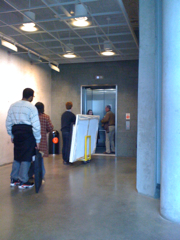
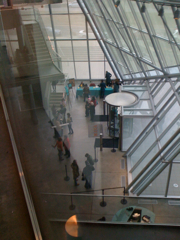
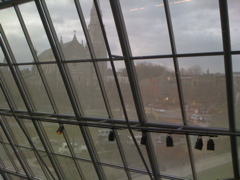
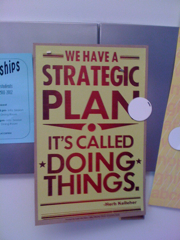
And now we’re at MICA, an art school that was founded in 1826. The students are all standing in different lines to have their art portfolios reviewed.
MICA is hosting a National Portfolio Day, and over 50 schools have come to review portfolios. The students have big dreams that someone here today will tell them they have what it takes.
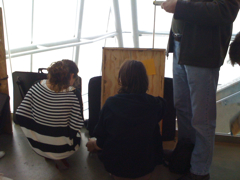
Freeboarder is in line to talk to The Cooper Union, one of the hardest schools to get into–if you’re accepted, you pay no tuition.
So of course the lines for this school are the longest, and the art is phenomenal.
Some of the parents are quite crabby with their kids. They’ve obviously invested a lot of money already in their children’s art, judging from the size and quality of some of the canvases I’ve seen.
I’ve found a quiet corner where I can study for my poetry final, but all I really want to do is eavesdrop and take pictures.

-
Dreams on Vacation
Too much sleep in the morning led to this dream: I’m lying on a recliner in an empty hall. The walls are white. A student with long dark hair approaches me and asks me to read her poem.
The problem is that I can’t keep my eyes open long enough to read the words.
Of course, we usually can’t read in our dreams. If you ever find yourself trying to read in a dream, you might be able to remind yourself that you’re dreaming, and become conscious in the dream.
I tell the girl she’ll have to read the poem aloud if she wants me to give her my response. I keep trying to open my eyes, catching glimpses of a column of typed words running down the middle of a white page.
In the end I force myself awake, without ever knowing what her poem was about.
 Balanced On the Edge