Balanced On the Edge

    • About Balanced on the Edge
    • Publications
    • Swimming This

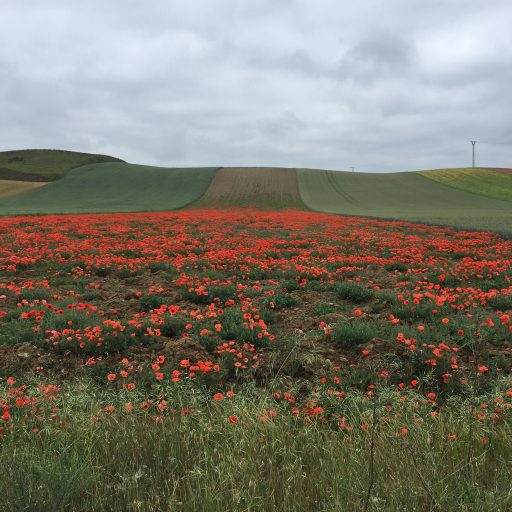
A field of red flowers and a cloudy sky
Camino de Santiago
  • Red Comes to Our House

    We have a new puppy at our house named Red. My sons brought him home from the animal shelter a week and a half ago, and we’re still working on finding a suitable routine. It’s summertime for me, which meant, until Red came, that I could read poetry, practice yoga, and meditate, in addition to housework and cooking meals, but all that free time has evaporated in my efforts to train the pup.

    The boys said he was six months old, but I’m not so sure. He chews on anything made of plastic, rubber, paper, or wood. One night he started chewing my toes under the blanket, not understanding the lumps were a part of me!

    Freeboarder has started back to school already–they’re moving to a year-round school year where we live–so today I walked Red and Duffy for two miles after he left for school. Red rolled in the creek to cool off, so now we’re on the back porch with the ceiling fans blowing until he dries off. It’s cool out here now, perfect for my morning reading and writing practices.

    I’ve been reading about dog behavior, a first for me. When I was a kid my dad paper trained our puppy, and scolded him for bad behavior with a rolled up newspaper he would slap on his hand behind our beagle’s back. But training techniques have changed in the last forty years. Dogs, like people, thrive from constant praise. When I taught school one of our adages was to “catch the children being good.” The same holds true for animals. There’s a lot to be said for B.F. Skinner and positive reinforcement.

    Positive reinforcement requires lots of attention and patience. I have to look Red in the eye and praise him when he’s behaving the way I want him to, like when he chews on his toys and not on the furniture. All this attention has shortened the time I can spend meditating, so I’m trying to think about my moments with him as my practice.

    I’m mindful of him, I praise him, and I give him affection. When he pees in the wrong spot, I clean it up and take him outside. Rather than getting angry, I practice patient acceptance. There’s a remedy to the situation–a gate, a crate, lots of trips to the backyard, and a few long walks a day.

    August 11, 2010

  • From Bowling Green to Barcelona and Seoul to Norwich

    Emily Elizabeth Schulten read from her collection Rest in Black Haw (2009, Summerfield Press) for the Solar Anus Reading Series at Beep Beep Gallery in Atlanta. Many of the poems from her book, rich with imagery of domestic life and the natural world, point to her Kentucky roots.  She also read a few pieces from her current work, which were written after her travels to Barcelona and Rome.

    One of the poems from her collection, “Labor Day Weekend,” was featured on Verse Daily. You can also read the blurbs on the back cover here.

    Before reading her later work, Schulten, who has traveled widely, remarked that her more recent poems reflect her thoughts about how we create the concept of home as we move through the world.

    Jim Goar, whom I had the pleasure of meeting for the first time at the reading, read a few pieces from his most recent book of poetry, Seoul Bus Poems. Goar told the audience that all the poems in the collection were written on the bus while he was working in Seoul. Great economy of words and meaning in the title, I’d say.

    Most of the work he read came from his latest project, a book-length serial poem based on his immersion in the Holy Grail legend, the focus of his studies as a PhD. student in Norwich, England. I look forward to reading the collection. I’d also like to learn more about his method of writing the serial poems.

    You can read more about Jim Goar at his blog, Can of Corn. Discover how he named his blog by reading his book, Seoul Bus Poems.

    August 8, 2010

  • Musings About "The Love Song of J. Alfred Prufrock"

    I’ll be honest, I’m not much interested in literary theory. When I read a poem I look up words I don’t understand or references that I’ve never heard of, but in general I prefer to figure out the gist on my own. That’s what’s fun about reading, isn’t it?

    I offer that statement as an apology for my musings about poems, because probably all of it has been said much better by someone else. So you could say I’m writing these musings for myself, or for some future reader who comes along, surfing the web the way some people still troll through microfiche.

    The Epigraph

    I took a course on modern British poetry many years ago, and I’ve read T.S. Eliot’s “The Love Song of J. Alfred Prufrock” several times over the decades, but I never bothered to look up the Italian epigraph until now, and I guess I should have, because it does inform the poem. Or it could be that I forgot the meaning after so many years.

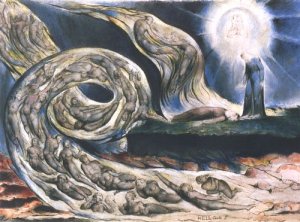
    william_blake_dantes_inferno_whirlwind_of_lovers
    William Blake: "Dante's Inferno, Whirlwind of Lovers."

    The epigraph comes from a section of Dante’s Inferno, and is the speech of a man who apparently committed some heinous misdeeds, because he’s consigned to one of the lower circles of hell.  Roughly, the stanza says the man would not tell the story of his sins if he thought the listener could return to the world to relate the man’s crimes, but since he has never heard of anyone escaping from the fiery pit, he will go ahead and spill the beans, or wag his flaming tongue. He has been so terrible that he has lost his human form, and has become only a tongue of fire.


    The Poem

    When J. Alfred invites the reader to go on a walk with him through the city streets, he believes we are with him in hell, never to return.  If he tells us what’s really on his mind, it’s because he thinks we’re stuck in this place with him.

    Prufrock admits he has tried to create a persona to win favors from the world. He admits he’s getting old, and reveals his paltry efforts to conceal his aging. He shows us his hurt when a woman he has either seduced, or tried to seduce, tells him, “That is not what I meant at all./That is not it, at all.”

    Yet he thinks he really does have something to say. He wants to come back from the dead like Lazarus to tell everyone about the “mermaids singing, each to each.” But he doubts himself. He doesn’t think he’s a prophet. He doubts the mermaids will sing to him.

    But what he has to say is that at night we dream we are mermaids riding the waves out to sea, and it’s only when we wake up that we drown.

    Prufrock is  like the rest of us ridiculous humans, caught up in our gains and losses, always thinking we have time to make our “visions and revisions/Before the taking of toast and tea.”

    Lately I’ve been reading about Buddhism and the need to follow the Dharma right now. We might die at any moment. It could be in an hour, when we drive to the market, or later on, while walking the dog. And so the need to die with a peaceful mind is of the greatest importance. Catholics might say something about needing to be in a state of grace during the moment of death.

    Prufrock obsesses about our having time for all the things we haven’t done yet. But really there is no time left for that. He knows his time is up, yet he clings to the idea of himself: parting his hair down the back, rolling his pants legs up, walking the beach in white flannel, all the images of himself as a lady’s man or an urbane gentleman amid the sordid yellow smoke of the city.

    The collection Prufrock (1917) is dedicated to Eliot’s friend Jean Verdenal who, according to the inscription, died at the age of 26 during WWI at Dardanelles. Maybe this character of Prufrock is a satire of Eliot himself and others. Through revealing the character’s weaknesses he exposes our frivolities and our vanities, which at our death amount to nothing.

    My favorite lines from the poem are these:

    But as if a magic lantern threw the nerves in patterns on a screen:

    and

    I have seen them riding seaward on the waves

    Combing the white hair of the waves blown back

    When the wind blows the water white and black.

    Those lines make me believe Prufrock might not be a bad sort at all. Because he has told us about the mermaids, after all. If he’s in hell, maybe he’ll have a chance to climb out of the pit.


    July 22, 2010
    T.S. Eliot, The Love Song of J Alfred Prufrock

  • A Spectrum of Aesthetics, Part II: Arda Collins

    casey - 07
    Off I 75 in North Georgia

    The following passage continues where I left off in the first post about contemporary poetry.

    Contemporary poetry, and contemporary art in general, reveals the Zeitgeist of the 21st century–we seem to live in a moment in which we are reevaluating the myths that motivate us; as a culture we question the roles language, poetry (or art), science, and religion play in our lives. This reconsideration of reality has produced eclectic collections from both younger and older poets.

    Each of the books we discussed this semester in our contemporary poetry course, in varying degrees, serves as a barometer of our country’s mood as perceived through the feelings and thoughts of the individual poet, although the psychological and emotional landscapes differ in their representation.

    I will identify some essential questions that underlie or motivate three of the individual projects, examining poems from It Is Daylight by Arda Collins, Matthew Dickman’s All-American Poem, and Claudia Emerson’s Late Wife. My hope is that these sample poems will serve as emblems for the poets’ overarching motivations to write, as well as illustrate the wide spectrum of aesthetics in contemporary American poetry.

    Among the books we studied, Arda Colin’s It Is Daylight represents the collection least inclined toward the Romantic ideal of union with nature. Luis Glück, who chose Collins’s collection for the Yale Younger Poet’s Prize, characterizes Collin’s poetry as “savage, desolate, brutally ironic” (vii).

    Glück later states that “[a]t the heart of the poems is shame, which results not from something the poet has done, but rather from being” (vii). Even though there is an overt depiction of shame in Collins‘ collection, I would say the heart of her poems also contains a desire to understand what being alive means to a neurotic speaker (whom we shouldn’t confuse with the author). (more…)

    July 10, 2010
    Arda Collins, Contemporary Poetry Debate, It Is Daylight

  • Painting on the Porch

    Freeboarder, back from the beach, has resumed painting on the porch. Right now he’s listening to the Flaming Lips while rendering an image from a dream he had about “the great god of nature.”

    I’ve spent the morning reading and shopping online for a used canoe. We didn’t join a community pool this year, so I’m thinking about taking advantage of the nearby river and lake for some outdoor fun.

    July 5, 2010
    art, canoes, painting, symmer

  • Wind and Waves

    Today is our last full day at Folly Beach in South Carolina. The wind is strong, and the waves are breaking at a perpendicular angle to the shore.

    I saw two guys wind surfing on boards that looked like snowboards. They were riding the waves all the way down miles of beach, at times shooting up twenty feet in the air. The upper body strenghth it must have taken to hold onto that parachute sail… .

    My son and his friend walked out into the surf, and the current took them down about five hundred feet. They kept getting out of the water and walking up the beach and swimming down current, as if it were a river.

    July 2, 2010
    beach, ocean, summer, vacation

  • What themes do you explore in your poetry? | Yuli Gugolev | Big Think

    http://ak.c.ooyala.com/cacheable/4569422c60271651428b3418ff724290/player_v2.swf

    via bigthink.com

    Gugolev’s response to this question is thought provoking, but a bit arch. I wonder how many poets and writers sit down to write by saying, “I’m going to explore this theme?” On the other hand, I could easily point out what broad thematic category my poems fall into.

    One of my teachers said all poems are about death, and he was only half joking.

    Usually I have a feeling, an image, a thought, or even a tangle of all three, that I start to work out in a free write. But when I look at many of the poems and stories I’ve written this last year, most of them revolve around sex, love, and death.

    What do you think? How would you respond to the question? Do you set out to explore a theme? Are you working on a particular project in which each story or poem is somewhat planned from the beginning? Or do you write individual poems that in the end seem to make a cohesive whole?

    June 21, 2010

  • A Spectrum of Aesthetics, Part I

    I’ve decided to post part of the final paper I wrote for a contemporary American poetry course. There’s a huge debate these days about academic writers versus those who write independently, but in my mind the rift is more about aesthetics and publishing trends. It’s also about, who owes us a favor, who wants to curry favor with us, how eager we are to have our work published, and the circles we travel in.

    Unfortunately, the best art is not always discovered within the artist’s lifetime, as we all know.

    To get an idea about what some critics are saying, read Anis Shivani’s review of The Best American Poetry, 2010. Be prepared for some harsh statements! Also relevant is The New Math of Poetry by David Alpaugh. Thanks to poet, novelist, journalist and all around brilliant writer Collin Kelley for posting these links and keeping me abreast of the controversy.

    I.

    Like the polarization of values found within the U.S. political system, the poetry world also disagrees about aesthetics: the New York School sometimes conflicts with Southern narrative poets; New Formalists  shake their heads at those who cling to Walt Whitman and the rule of free verse.

    With the growth of the Internet and the ability to write and share poems by merely lifting the lid of a laptop, poetry, the people’s art, reflects the diversity of those who write it. Academic poets compete with coffee house, spoken-word artists for readership and attention.

    Nature poets espouse a return to the woods for inspiration, writing haiku and renga in the manner of Basho; other poets have embraced a postmodern ethos that reflects a strong sense of irony. The latter express an art form that some identify with an outgrowth of a scientific worldview that rejects religion as an answer to life’s mysteries.

    Some literary theorists, philosophers, and even poets would go as far as to argue the irrelevance of the question “where did we come from and where will we go when we die?” But as Edward Hirsch explains in How to Read a Poem, even poetry of despair is a calling out to humanity, and signals a kind of hope. When he claims that “[d]espair is a turning away from human commerce, it is silence” (157),  he defends the act of writing about despair as a signal of wanting to connect with the other.

    ***

    View of the Hudson (photo taken by my husband)
    View of the Hudson (photo taken by my husband)
    June 17, 2010
    Contemporary Poetry Debate

  • Poems About Motherhood

    When my sister first told me about the documentary she worked on at CNN, “Atlanta Child Murders,” I didn’t know if I would watch it. I remember that grisly time in Atlanta, when so many children were found dead in woods and rivers.

    But I was a teenager then, and I was in a self-involved frame of mind. I didn’t consider, like I do now, the horrendous grief of their mothers.

    Now I’m the mother of two young men. I worry about them whenever they drive off in a car, which is why I didn’t want to watch the documentary.

    But I did watch it. And the mothers’ grief moved me the most. I realized that I’ve been mourning in advance for what might happen to my sons. Better to grieve with the women who lost their children, rather than wallow in the imaginary fate of my boys. It’s a lesson in compassion.

    I wrote a poem in memory of the murdered children, a pantoum about worry and grief that starts with a sentence from a Buddhist parable: “The living are few but the dead are many.”

    The lesson of the story is that we aren’t alone in our suffering. One mother’s loss is the loss of all mothers.

    June 14, 2010
    and Compassion, Atlanta Child Murders, grief

  • Nothing But Questions

    Jack Gilbert is my new favorite poet, thanks to my friend KR. I’ve been reading his collection, _Refusing Heaven_, and through the reading (as well as my own meditations), I’ve come up with some questions I’ve written in my journal.

    There’s a mindful quality to Gilbert’s work that motivates me to reflect about how I live my life.

    Questions:

    What moment is worth the sorrows yet to come?

    When did you last feel joyful?

    What is June silence?

    Why were you angry?

    What do you fear?

    June 7, 2010
    Jack Gilbert, journaling

Previous Page Next Page

Blog at WordPress.com.


Loading Comments...
 

    • Subscribe Subscribed
      • Balanced On the Edge
      • Join 241 other subscribers
      • Already have a WordPress.com account? Log in now.
      • Balanced On the Edge
      • Subscribe Subscribed
      • Sign up
      • Log in
      • Report this content
      • View site in Reader
      • Manage subscriptions
      • Collapse this bar