Balanced On the Edge

    • About Balanced on the Edge
    • Publications
    • Swimming This

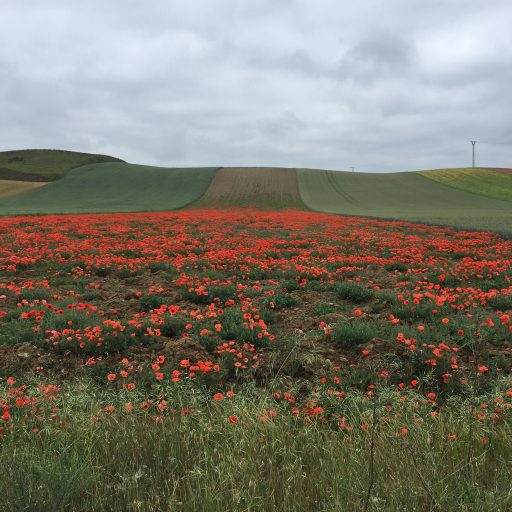
A field of red flowers and a cloudy sky
Camino de Santiago
  • A Review of Slamming Open the Door by Kathleen Sheeder Bonanno

    The professor of my contemporary poetry course has given us each a chance to present a book published within the last ten years. My presentation was over Slamming Open the Door, (Alice James Books, 2009) by Kathleen Sheeder Bonanno. We discussed the book mostly in terms of its overall effect as a project. The topic is every parent’s worst nightmare–the death of a child. Ms. Bonanno’s daughter Leidy was murdered by an ex-boyfriend, and the book chronicles some of the moments of the family’s trauma, from the night she and her husband find out what happened to their daughter, to the trial, and the memorial service.

    It’s a gut-wrenching book that is successful as a collection because it stays very honest–the speaker allows the reader a glimpse into her experiences, without decoration or maudlin metaphors. The poems read as though they were written in the moment, yet they are grounded in concrete images. The pacing and sequencing of the poems are also effective. There are flashbacks to when Leidy was adopted, as well as to her graduation party, where the killer  first appears.

    Slamming Open the Door does not come out of an academic tradition of poetry, even though the author is a contributing editor of The American Poetry Review. Although American literature includes countless examples of poems about grief, most of the poems in our literary canon are either formal, or pay great detail to the flow of the language.

    To me, writing  highly stylized poems would not accurately portray the raw grief of a mother whose daughter has been strangled to death. On the other hand, staying true to the bestial nature of raw grief requires a certain measure of control that Ms. Bonanno maintains throughout the work. These are poems that had to be written, as the speaker explains in the first poem of the book, “When Death Barged In.” If the book were mine, I imagine I’d have to force each line to appear on the page, while at the same time feeling the utter necessity to write them down.

    The intended audience seems to be anyone who has suffered an immense loss, whether it be the death of a child, or a spiritual loss of some kind. Anyone who has lived through tragedy would  sense that for a brief moment in time, the speaker was able to relieve herself of her enormous grief by sharing it with others. I hope the writing was therapeutic for Kathleen Sheeder Bonanno. Her family, and Leidy, are in my thoughts and prayers.

    I first heard about Ms. Bonanno’s collection while listening to Terry Gross’s interview with her on NPR. I highly recommend listening to the interview–Ms. Bonanno reads several of the poems with feeling and inflection. Her sorrow and rage come across in the reading, as does her self-effacing sense of humor.

    In his New York Times review of Slamming Open the Door,  poet David Kirby brings up the concept of subjects for art that some have considered taboo, such as the Holocaust, but  he then defends Ms. Bonanno’s writing by saying that the raw nature of the poems redeem them from any criticism that she might be exploiting her tragedy to make art.  One of my classmates mentioned that art is often born from an apocalypse, as Elie Wiesel proved with his memoir, Night. Our professor also cited the poetry of Paul Celan as an example of poetry that has come out of the Holocaust.

    One of the reasons I chose Slamming Open the Door is because I’m searching for a way to write about my own life in the form of poetry. I ask myself, how does one write about an event without turning it into a plea for pity or a tract against others? How do we make sense of past events without, in my case anyway, unduly exonerating ourselves? Ms. Bonanno didn’t allow herself to escape uncriticized in her poetry memoir. She put herself under the spiritual microscope as much as she did her daughter’s killer.

    Poet Andrew Hudgins,* in his essay, “The Autobiographer’s Lies,”  writes about using one’s own life as material for poetry. He discusses the idea of how looking at the events in our lives distances us from the story and gives us the ability to look at ourselves as characters in a play or a novel.

    In her interview with Terry Gross, when discussing her poem “How to Find Out,” Ms. Bonanno states that she felt she was acting out a role she had been given by fate: “Mother of the murdered daughter. So in effect, I use – I speak directly to the reader in second person in the poem “How to Find Out” as if now that I’ve gone through this, I’m capable of teaching the next actor in the play.”

    Of course, in actuality there’s nothing really that could prepare us for this type of monstrous grief. The directions Ms. Bonanno gives us are almost ironic, because the subtext is that there is no rehearsal for how we will react to the murder of a child. No cop dramas on TV, no courtroom scenes, not even honest poetry can ever completely prepare us for a scene we never want to be in.

    The most we can do is read the poems and try to put ourselves in the speaker’s place. Because on a spiritual level, what happens to one of us happens to us all. As Annie Dillard has said, we are all swimming together in the same tide of time. For this reason, I’m very glad Ms. Bonanno has had the courage to write about her experiences. We who read the book will put on our sack cloth and cover our faces with ash along with the speaker, on a spiritual level.

    Slamming Open the Door is a mother’s wail to the universe. That huge loss we know is coming, the day our child  leaves home to strike out on her own, descended upon this mother like a monster, and part of her life’s journey now is to slay the beast that this loss has created. The book has become the speaker’s rite of passage,  a boat to transport her to the side of time where she can get up in the morning and go to work with at least a glimmer of hope that the grief will someday subside.

    Because of the brutal honesty of this book, the sequencing, the simplicity of the language, and the many concrete images, Slamming Open the Door is a highly convincing, successful collection.

    * Thanks to Dana Guthrie Martin for sharing this essay with me on her thought-provoking blog, My Gorgeous Somewhere.

    February 6, 2010
    grief, Kathleen Sheeder Bonanno, Slamming Open the Door

  • Are you afraid to fly?

    We’re just finishing Pathways to Bliss in my poetry course, and then we’re going to read the first two essays from Man and His Symbols, a collection of essays edited by Carl Jung for the everyday person. I’m ready to take on Jung after Campbell’s excellent recap  of modern psychology in Pathways to Bliss, from Freud to Adler, and from Jung to Maslow.

    In Jung’s introduction he says the basic function of dreams is to restore psychic balance in our lives. We tend to evade the truth in our waking life, and dreams try to open us up to modes of behavior we might not be ready to admit to ourselves. Dreams can also reveal our hidden potentials to us. As an example of the former, Jung says,

    “It explains why people who have unrealistic ideas or too high an opinion of themselves, or who make grandiose plans out of proportion to their real capacities, have dreams of flying or falling.”

    I love to have flying dreams. Even the ones where I just bounce around. When I wake up I feel exhilarated, ready to take on any challenge, especially artistic challenges. But after reading this passage, I began doubt myself again. I started wondering if I’m like some of the poor schmucks on American Idol, self-delusional with little chance of a public reception of my work. I don’t want to be someone who says, Well, the world just isn’t ready for me yet.

    On the other hand, I also ask myself if I would continue to write poetry and short stories if no one else read them. I think I would. I would be my own reader, which is basically my current situation anyway. And since I prefer to continue writing no matter matter what, I interpret my flying dreams as meaning I need to embrace my hidden potential that I didn’t have the confidence to see until I flew.

    February 3, 2010

  • Joseph Campbell and Poetry

    via empirecontact.com

    In one of my poetry classes we’re reading about the link between myth making and poetry. Currently we’re studying An open Life by Joseph Campbell, and next we’re reading Pathways to Bliss.

    Campbell has a lot to say about the role of poets in today’s society. He discusses how the old myths and rituals no longer serve people the way they did even 50 years ago, and that it’s the role of the poet to create new myths to sustain our need for a connection between the outer world and our inner lives.

    Campbell’s study of Native American cultures lead him to his research of world myths. And after studying Jung and seeing the work of artists like Picasso and Paul Klee, he came upon his theories of the monomyth, The Hero, and The Call, which he describes in his seminal work, The Hero with a Thousand Faces.

    I read Hero a few years ago, but there’s so much to it that I’m pleased to have this chance to dive back into Campbell’s work. It’s a challenge, not only to base poems on old myths and fairy tales, but to create new, relevant myths through poetry. Film has done it: Star Wars, The Matrix, and now Avatar are a few examples of the Hero Myth in contemporary culture.

    But what about poetry? Has poetry lost the ability to move the populace at large? Has film replaced poetry for the masses? I’m just asking.

    January 19, 2010

  • How Conceptual Metaphors are Stunting Web Innovation: Found on Mashable

    via mashable.com

    This article illustrates the importance of language in all spheres of life. How we create metaphor is a metaphor itself for the process of invention and discovery. We are either looking backward to name what we want to create for the future, or we look at the world around us and make analogies. This article explores some outdated terms we still apply to the web, such as “documents.”
    http://mashable.com/2010/01/13/conceptual-metaphors/

    I’m reminded of “Advice to a Prophet” by Richard Wilbur, which has several stanzas on the creation of figurative language:

    Speak of the world’s own change. Though we cannot conceive
    Of an undreamt thing, we know to our cost
    How the dreamt cloud crumbles, the vines are blackened by frost
    How the view alters. We could believe,

    January 13, 2010

  • Snow Day North of ATL

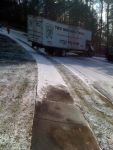
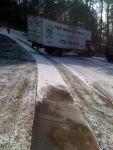
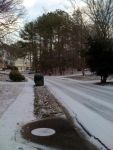
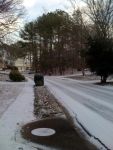
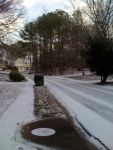
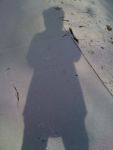
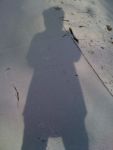
    Not that anyone needs to know, but my derriere was already sore from Vicki’s challenging yoga class yesterday, so slipping and falling on my butt while going down an icy slope didn’t help matters. But the extra padding with which nature has endowed me came in handy, and now I’m fine, drinking tea and eating leftover candy canes.

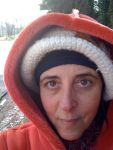
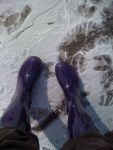
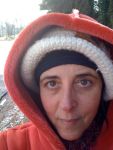
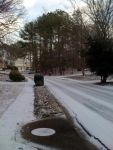
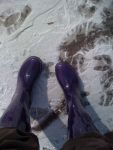
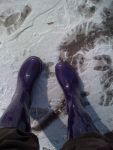
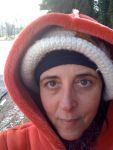
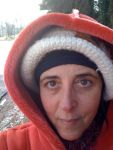
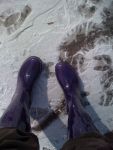
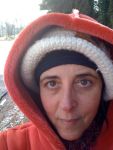
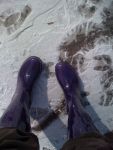
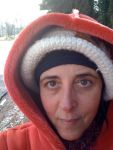
    Most sensible people stayed inside today in my city, but not wanting to feel trapped, I debuted my new purple boots and my red pleather parka and headed out to meet the sharp, cold air. A dusting of snow made the sidewalks less slippery, and the tread on my new boots saved me from all but one fall.

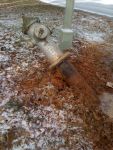
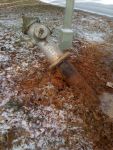
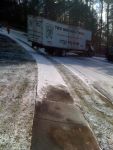
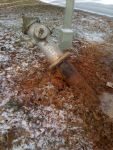
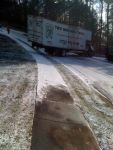
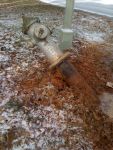
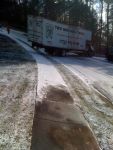
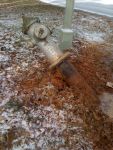
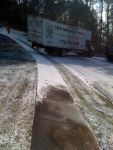
    A little boy who stood guard at the top of a hill said,”I saw these two cars crash into each other, and then one of them hit the fire hydrant, so I’m trying to get people to turn around.” The kid had a lot more sense than the drivers, because on my way back he was still there, bemoaning the fate of a moving truck stranded at the foot of the hill.

    My house is drafty, and there’s a chill in the air no matter how high we turn up the heat, but still I’m grateful. So many people are outdoors because of homelessness, or even if they have a roof over their heads, they can’t afford to turn on the heat. Walking three miles in the cold has made me sleepy, even though I was bundled up, and it makes me think about how hard and tiring it is to live on the streets.

    The crows and hawks were out today too, but the squirrels stayed snug in their nests.

    January 8, 2010
    ice, snow, winter

  • Sforza Horse

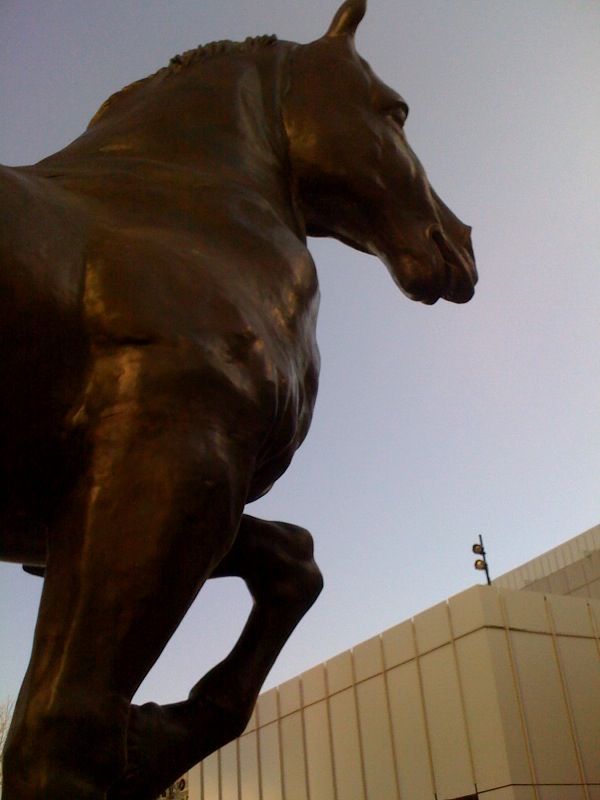
    In bronze, by Leonardo Da Vinci. It’s a replica of the original. In the exhibit we saw all his detailed drawings of equine anatomy, which he sketched from every conceivable angle.

    Sent from my iPhone

    December 29, 2009

  • Mythy Mind

    My word for 2010 is myth. I’m hoping to delve into any kind of myth, to create and re-create my own tales, poems, and videos. An exploration of myths goes along well with dream studies, symbolism, archetypes, folktales, fairy tales, songs, and poetry. I’m also interested in personal mythologies and urban myths.

    The word came to me while I was folding clothes. Isn’t that the way it usually happens? While we do a repetitive action, like making the bed or washing the dishes, stuff bubbles up.

    Thanks to Jessica-Fox Wilson for introducing me to this project, One Little Word, by Alie Edwards.

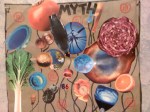
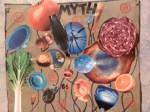
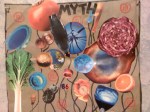
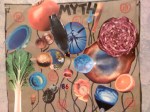
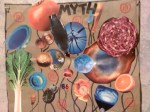
    The collage at the top of the page is my first nod to myth. I scanned old magazines while looking for anything that reminded me of myth, and ended up with lots of circles and ovals. I connected them with lines, as if they were balloons, and added a stamped spiral for the fun of it. The background is a recycled grocery bag.

    Sometimes I make collages as a way to get back into my creative space. It’s relaxing and meditative, plus it opens the door for writing.

    December 28, 2009
    myths 2010, One Little Word

  • Write Your Thesis in One Word

    via everythingfeedsprocess.com

    Poet, writer, educator, and blogger Jessica Fox-Wilson has a reflective fin de siecle post on her blog, Everything Feeds Process. The post is titled “The Monster Year-End Wrap Up & New Year’s Goals.”

    http://everythingfeedsprocess.com/2009/12/27/the-monster-year-end-wrap-up-new-years-goals-post/

    In the post she mentions another blog with a great concept, called One Little Word, by Ali Edwards, a writer and scrapbook maker. The idea is to come up with a theme word, and to create something based around that word for 365 days.

    Go to Ali Edward’s blog to find out her word for 2010:
    http://aliedwards.typepad.com/_a_/2009/12/one-little-word-2010.html

    Jessica participated last year with the word “essential.” If you read her post you’ll see how she implemented this word in her life.

    My word, which I think chose me, is MYTH.

    December 28, 2009

  • Christmas Tree Angel

    via facebook.com

    An angel from the sixties. My mom used to have her on our tree when I was a child. She gave her to me, and then my boys took turns throughout the years placing her on top of our tree. This year the honor reverted back to me! She’s a kitschy little gal–gotta love her choker and pipe cleaner arms, the gossamer cape and glitter evening gown.

    December 20, 2009

  • Avatar creates an amazing world: direhorse [Pandorapedia]

    Common Name Direhorse
    Taxonomy Equidirus hoplites or “feared armored horse”
    Habitat Rainforests and grasslands, but adaptable to most Pandoran environments. A grazing animal that has been domesticated by the Na’vi as a riding animal.
    Anatomy Horse-like creature with six legs, tough skin with no fur, long necks and small head, bold stripes, flexible carbon fiber armor over shoulders and along the back of the neck and head.
    Feeding Ecology Land omnivore that uses long snout to feed on sap. some protein intake through insects trapped in sap. Favored food is direhorse pitcher plant. Effective pollinator.
    Size Over 4.25 meters long, up to four meters in height
    Notes Animal has neural interface that allows Na’vi and direhorse to move together with apparent effortlessness. A highly intelligent, calm creature that, like the Na’vi, can turn fierce in the face of battle.
    via pandorapedia.com

    Avatar is a must-see movie for SF lovers and aficionados of animation!

    December 19, 2009

Previous Page Next Page

Blog at WordPress.com.


Loading Comments...
 

    • Subscribe Subscribed
      • Balanced On the Edge
      • Join 241 other subscribers
      • Already have a WordPress.com account? Log in now.
      • Balanced On the Edge
      • Subscribe Subscribed
      • Sign up
      • Log in
      • Report this content
      • View site in Reader
      • Manage subscriptions
      • Collapse this bar