Balanced On the Edge

    • About Balanced on the Edge
    • Publications
    • Swimming This

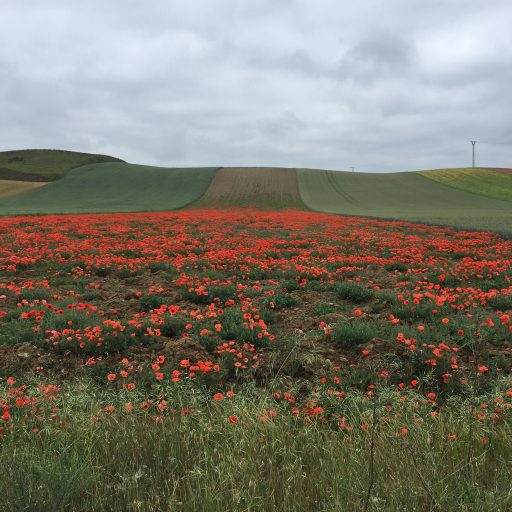
A field of red flowers and a cloudy sky
Camino de Santiago
  • journal entries and election angst

    10/29

    Ben and I stood in line for two and a half hours to vote. The sun shone brightly, but the wind was sharp, and my toes went numb inside my sneakers. We made friends with a woman in line, who opened up after I let it be known that we were voting for Barack Obama. She said, “I don’t think he’s going to win. I don’t think America is ready for a black president.”

    How sad if her fear comes true. I realize she was expressing her doubts because she was trying to ward off huge disappointment. Many of us feel the same way. We need Barack to win the election, to take us into the twenty-first century, and to help heal the wounds slavery caused.

    When I got home from voting I was chilled to the bone, and worn out. I crawled under the covers, still wearing my corduroy jeans and a sweatshirt, and slept for an hour.

    10/30

    A man in the tire store waiting room told me he was from Miami after he heard me mention the word immigration to the store manager. “It was a great place to grow up,” he said, “ lived and worked there for over fifty years, but now it’s a third world country.”

    He sounded bitter. I can see how crime and poverty might make living conditions where he once lived problematic. But third world country? The bitterness? It sounded like he was blaming the immigrants for the problems, an opinion with racist overtones.

    I didn’t tell him how much I loved Calle Ocho when I was in Miami many years ago, or how I enjoyed speaking and hearing Spanish, sipping espresso with a sliver of lemon rind at outdoor cafes, seeing men dressed in guayaberas, the women sauntering in brightly colored skirts, high heels, perfect make up and glossy hair.

    11/2

    My son Freeboarder said, “Sarah Palin is not a leader, she’s an enforcer, and a pretty thick-headed one at that.” He’s fifteen! Out of the mouths of babes, as they say.

    11/3

    To all the Obama supporters: don’t boo, just vote.

    November 3, 2008
    Barack Obama, presidential election, racism

  • The House of a Thousand Stairs

    The House of a Thousand Stairs

    Al Capone and his gun moll Myrtle slip
    down the Chattahoochee in a canoe,
    their faces dappled with moonlight and shadows.
    Water runs over rocks, owls call,
    breath puffs in humid waves.

    They reach a wooden dock camouflaged
    behind honeysuckle vines, magnolias,
    climb with muffled footfalls the stones leading
    to The House of a Thousand Stairs, Capone’s
    hideout when he can’t take Chicago’s heat.

    This is the tale we tell around campfires
    at the top of a cliff on the river’s edge. Passing
    a joint, we speak of Capone’s getaways to a mythic
    piedmont, dare each other to descend stairs
    cut into granite, count steps leading to dark currents.

    But there is no house, only a bare patch of earth,
    boulders, scrubby bushes, a remote enclosure
    for teenage gatherings on muggy Georgia nights,
    unseen by the law. We cartoon caricatures
    of ourselves as the keepers of Al Capone’s

    former lair, possess secret knowledge, are privy
    to underground rumblings of the past, have truck
    with danger, can hold our own in a world of mystery,
    as we congregate on the ruins of renegades,
    The House of a Thousand Stairs.

    ***

    Visit Tom’s prompt on read write poem for more gothic-like poetry.

    October 31, 2008
    Al Capone, Georgia, myths

  • Nancy K. Pearson's Two Minutes of Light

    While idly surfing the web, I came across this poem by Nancy K. Pearson, entitled, To the High School Prom Queen. When I read how the narrator addresses a former prom queen who is now behind bars, I knew I had to read the entire collection.

    Pearson’s first book of poetry, Two Minutes of Light, was published by Perugia Press, a company that publishes only one book a year, a first or second collection by a female poet. Those are some slim odds, that one’s book would be picked up by Perugia, which is another reason I decided to order Pearson’s book. I figured she would have to be an excellent poet, if a company would put their whole year’s productivity into the publication of just one book, and had chosen hers.

    Pearson explores some tough topics: self-mutilation, drug addiction, accidental death, suicide, and sexual abuse. But she explores the evolution of a person who emerges from pain and darkness, and who is able to bank on the beauty and love she finds in the world. The narrator pulls herself out of hell.

    The poems seem to be written in a minor key. The words are simple, punched up with an occasional reference to the South, or to a name-brand regional store. The narrator pays attention to the natural world, which is observed because of, in spite of, or after suffering. If ever there was a book to inspire people to hang on, to embrace life rather than succumbing to despair, Two Minutes of Light is it. But Pearson conveys this message through the narrator’s slow climb out of hell, not by preaching or extolling any particular set of beliefs.

    In an interview with Melora B. North from the Provincetown Banner, Pearson says that although the poems in Two Minutes of Light, ” are not autobiographical, they obviously mirror her life in many ways and are based on her not always pleasant observations and experiences.”

    Again we have a poet who needs to make a disclaimer about her seemingly confessional poems. I understand Pearson’s need to clarify herself, given the assumptions many people make about poetry. Even if she uses the first person, the poet is reconstructing a past that no longer exists. A poet tries to remain faithful to the feelings, and uses whatever devices are available to her to recreate, to share, to allow the reader a glimpse of a different reality.

    Pearson successfully creates a character who survives, and even goes on to thrive, because she feels an attraction to the raw beauty of the world, to the pleasures of living.

    October 29, 2008
    Nancy K. Pearson, Perugia Press, Two Minutes of Light

  • Night of the lagoon

    The following might be a poem, or a story, I’m not sure which. I wrote the piece first in Spanish, and then translated it into English. Something about the narrative reminded me of one of my favorite South American authors, Horacio Quiroga, so I wrote it first in Spanish.

    Please listen, if you have time. It took me almost an hour to figure out how to upload the darn file! But now I know how. That’s how it is when we have to teach ourselves, a lot of trial and error.

    A poetry workshop leader said recently that she didn’t think it was fair to use symbols from dreams in poems. The symbolism is too personal, too obscure to be understood. But to me, the image of the water seemed universal. Who hasn’t dreamed of dark water, or being swept up by giant waves? And the neighbor is more than likely myself, seen as the other.

    Tell me what you think. Is it fair to use dream imagery in poems?

    noche de la laguna/night of the lagoon (audio)

    Noche de la laguna

    Anoche soñé que una inundación
    subió hasta el segundo piso de mi casa.
    Todos salimos a las terrazas
    para averiguar por qué el aire sabía a ranas.

    Era de noche, y la luna se reflejaba
    en un espejo oscuro de agua.
    Me inliné sobre el balcón, pensando
    ¿cómo voy a escaparme?

    En los jardines las coronas de los árboles
    se asomaban de la laguna como enormes
    caras de hombres frondosos. Desde su terraza
    mi vecina de al lado se clavó los ojos

    en los míos y me dijo, sin sonido,
    como sólo ocurre en los sueños,
    – No fui yo. No me eches la culpa.
    Tenía razón, la pobre. Siempre le culpaba

    por todo. Volteé la cabeza, fastidiada.
    Esta vez me empeñé en no bañarme.
    Me acordé de las otras veces cuando sí
    nadé en los ríos sombríos, atiborrados

    de cocodrilos de color azabache,
    o cuando me encaré con un muro
    de olas que me tragó y me tiró
    hasta las profundidades.

    Volví al interior de la casa, y cerré la puerta –
    por esta vez una solución sencilla se me ocurrió
    antes de despertarme.

    ***

    Night of the lagoon

    Last night I dreamed that a flood
    rose to the second floor of my house.
    We all went out to our back porches
    to find out why the air smelled like frogs.

    It was nighttime, and the moon was reflected
    in a dark mirror of water.
    I leaned over the balcony, thinking
    how am I going to escape?

    In backyards crowns of trees
    rose from the lagoon like giant
    faces of leafy men. From her porch
    my next door neighbor fixed her eyes

    on mine and told me, without sound,
    as it happens only in dreams,
    “It wasn’t me. Don’t blame me.”
    She was right, poor thing, I always blamed

    her for everything. I turned away, annoyed.
    This time I was determined not to bathe.
    I remembered the other times when
    I did swim in dark rivers teeming

    with jet-colored crocodiles,
    or when I faced a wall of waves
    that swallowed me and threw me
    to the depths.

    I went back inside and closed the door –
    for once a simple solution occurred to me
    before I woke up.

    October 27, 2008
    dreams, Horacio Quiroga, Spanish

  • We Feel It

    The following prose poem is a free-write based on two inspirations: Dana’ Guthrie Martin’s echolalia post, and Michelle Obama’s campaign speech today in Ohio. I was listening to Michelle’s inspiring speech on CNN today while folding clothes. As she began a number of sentences with “we feel it when,” I thought of echolalia, and the conversation on Read Write Poem.

    We Feel It

    “It’s causing us to be in survival mode.”

    From Michelle Obama’s campaign speech, Friday, October 24, 2008, as she referred to the global economy.

    We feel it when we say goodbye to a son who is traveling far away, or when the line is disconnected while talking to a friend.

    We feel it when a door won’t unlock, no matter how much we jiggle the knob, when our dreams turn to ash, when art turns to dust, when someone laughs at our efforts to reach into the airwaves to pluck a thread of inspiration from the ether. When we hear angels tapping their lotus petal feet on a distant island; when we hear the bellows of beasts in the dank basement of our soul.

    We feel it when we deny ourselves the right to enter glowing orbs of goodness or empty cupboards of despair.

    We feel it when we are told our time is past, we are creaking bones and gray hair with a one-way ticket to a walkabout leading to an incinerator.

    We feel it when a man is unjustly accused, when lies do go on forever.

    We feel it when the horizon’s flat line becomes the universe, supported on the backs of the emperor’s sycophants, who will forever love the new clothes.

    October 24, 2008
    dana guthrie martin, Michelle Obama, read write poem

  • Protected: everything is a sign

    This content is password-protected. To view it, please enter the password below.

    readwritepoem, wordie prompt

  • Some poems on the web

    Postal poetry has posted a poem I wrote for Fernando Sousa’s photo 666.

    Juliet Wilson’s Bolt’s of Silk has one of my poems up this week, entitled “swamp hypnosis.”

    October 21, 2008
    Bolts of Silk, Fernando Sousa, Juliet Wilson, postal poetry

  • a response poem

    Dear Jo,

    A poet from Spain once told me
    he never saw any people in our
    suburban county town. “You keep
    to your colonies like ants, leave
    your pods only when encased in a shell.”

    I know a boy who stares other drivers
    in the eye when he stops his car
    at a red light. “I have an intrusive
    personality,” he says, “I feel
    compelled to make my presence known.”

    On warm Madrid evenings families
    gather in the plaza to sip tinto
    de verano
    , admire strolling youth,
    listen to street musicians. Parents
    gossip while children kick a soccer ball
    in front of an ancient church.

    Are we strangers, we who circumnavigate
    space together on the same wheel of time?

    2

    2

    This poem is a response to Jo Hemmant’s poem “close,” found on her blog, florescence. Dave Bonta, author of via negativa, has been writing several of these response poems over the last month. It’s a great way to acknowledge another writer, and to carry on the thoughts and feelings generated in the piece.

    October 15, 2008
    city life, dave bonta, Jo Hemmant, loneliness, response poems

  • who is speaking?

    This post is a continuation of a post I wrote at Read Write Poem about persona poems. Go see!

    In many poems, the narrative voice is in the first person singular. I’ve heard writers complain about how they’re tired of writing about themselves, how they don’t want to be self-obsessed, and I’ve also heard readers complain about how so and so is forever writing about herself, is a narcissist with no sense of the world outside.

    But are we always writing about ourselves when we use the pronoun I ? As noted in the Poet.org article entitled “Poetic Technique: Dramatic Monologue”, TS Eliot created characters in his poems who spoke about certain ideas and situations the poet wanted to investigate or draw out. In “The Love Song Of J. Alfred Prufrock,” no one would mistake the narrator of Prufrock as the poet himself. In this poem, Eliot is taking on the persona of the modern man, breathing life into him through the character of J. Alfred Prufrock.

    When discussing or commenting on the work of others, it’s important to ask, “who is the narrator?” Just because the author is female doesn’t mean the narrator is. One of the privileges of being a poet or an artist or an actor is that we use our imaginations. We explore what it might be like to live under certain conditions. We might be able to find a historic character to investigate, someone who actually lived who exemplifies an idea or an image we want to understand. Or we invent.

    And it might be wise to remember that even when we think we’re being honest with ourselves about writing the brutal truth, we still might be harboring certain illusions about ourselves that transfer onto the page. I’ve caught myself holding back when I write for any number of reasons What ends up in the poem is my invented self, the woman I want to be, but maybe not the person I am. We continuously create the persona we admire. Narcissism is a deep, shiny pool, and we all love to gaze into it.

    How many of you have had readers confuse the narrator in the poem with you? Have you ever had someone assume you were writing about, say, your own failed marriage, when in fact you were merely exploring what could be, or what might have been?

    What about personas in your poems? Have you breathed life into a literary figure from the past, a historic personage, or even a character you made up?

    To read more about the idea of persona poems, please visit my column at read write poem, “get the lead out, it’s noting really.”

    October 15, 2008
    dramatic monologue, persona poems, The Love Song of J Alfred Prufrock, TS Eliot

  • not a problem to be solved

    Sometimes yeti clans appear
    in the yellow-white spheres

    of my headlights when I pull
    into the driveway,

    faces dilated, they are paralyzed
    in the halogen glow, the bulk

    of their hirsute bodies creased
    forward, poised to jump.

    I leave the engine idling,
    wait to see what they’ll do

    if I hold them frozen in my beams,
    plastic bags, clenched in their fists,

    full of discarded pizza slices
    and apple cores picked

    from the garbage can on the side
    of the house. One might reach

    a hand into the bag, sneak a bite
    of food to her mouth, chomp

    down on cold, tough pizza
    with a faraway look in her eyes.

    Then they sashay in pairs
    toward the shadows, a nonchalant

    do-se-do to places I’ve never visited,
    to the caves and hollows where yetis

    dwell when no one is looking.

    8

    8

    8

    The prompt from last week at read write poem is about dinosaurs and monsters.

    *Yeti, 1937, from the Tibetan; a small humanoid creature said to live somewhere in the Himalayas.

    October 12, 2008
    mysteries, read write poem, yeti

Previous Page

Blog at WordPress.com.


Loading Comments...
 

    • Subscribe Subscribed
      • Balanced On the Edge
      • Join 241 other subscribers
      • Already have a WordPress.com account? Log in now.
      • Balanced On the Edge
      • Subscribe Subscribed
      • Sign up
      • Log in
      • Report this content
      • View site in Reader
      • Manage subscriptions
      • Collapse this bar